
Not long ago, automating a browser meant learning Python, installing Selenium, wrangling ChromeDriver versions, and debugging scripts at 11pm because a CSS class changed. Browser automation was firmly in the developer’s domain — and non-developers had no real alternative.
That era is over. A new generation of no-code browser automation tools has emerged, and the gap between “I wish this was automated” and “this is now automated” has collapsed from weeks to minutes. This guide is written for the non-developer who wants practical, working automations — without touching a single line of code.
What Is Browser Automation?
Browser automation is the practice of instructing a web browser to perform tasks automatically — tasks that a human would otherwise do manually. This includes:
- Clicking buttons and navigating pages
- Filling and submitting forms
- Extracting text, data, or images from pages
- Monitoring pages for changes
- Chaining multiple actions in sequence
The browser is the universal interface for the modern web. If a task involves a website, there’s a good chance browser automation can handle it — regardless of whether the site has a public API or any integration options at all.
The Old Way: Code-Based Automation Tools
Traditional browser automation tools were built by developers, for developers. The most common ones include:
- Selenium — the original headless browser automation framework, primarily used with Python or Java
- Puppeteer — a Node.js library for controlling headless Chrome
- Playwright — Microsoft’s modern, cross-browser automation framework
These tools are genuinely powerful. Large engineering teams use them for automated testing, data pipelines, and scraping infrastructure. But for anyone without a software development background, they present significant barriers:
- Requires programming knowledge (Python, JavaScript, etc.)
- Needs a local development environment or cloud server to run
- Scripts break when websites change their HTML structure
- No visual interface — everything is code
- Debugging requires understanding stack traces and browser internals
The learning curve is steep. For a non-developer who just wants to stop copying and pasting data between tabs, this is not the right tool.
The New Way: No-Code Browser Automation
No-code browser automation tools flip the paradigm. Instead of writing scripts that describe what should happen, you show the tool what to do — visually, by pointing at elements on the page and connecting logic blocks together.
Agentic Workflow is a Chrome extension that brings this approach to the browser itself. It provides a node-based visual editor where you build automation workflows by dragging and connecting blocks — no code, no server, no infrastructure required. Every workflow runs directly in your browser, on the live web page, as you. For a deeper look at how to automate websites that don’t offer an API, the same principles apply whether you’re a developer or not.
This is a fundamentally different model from server-side scraping tools. Because it runs inside the browser, it works on:
- JavaScript-heavy single-page applications
- Pages that require login
- Dynamic content that only renders after interaction
- Internal tools and intranets your company uses
What Can a Non-Developer Automate?
More than you’d think. Here are real categories of tasks that are well-suited to no-code browser automation:
- Data extraction — Pull text, prices, names, links, or tables from any web page into a usable format
- Form filling — Auto-populate repetitive forms with structured data
- Content monitoring — Watch a page for changes to a specific element and alert you
- AI summarization — Extract page content and pass it to an LLM to get a summary, translation, or classification
- Research workflows — Visit multiple pages, extract specific fields, compile results
- Workflow enhancement — Add new capabilities on top of tools your company already uses, without involving IT
If you can do it manually in a browser, there’s a strong chance you can automate it with Agentic Workflow. For a concrete look at specific tasks AI can handle in the browser, the range is broader than most people expect.
Getting Started with Agentic Workflow (Step-by-Step)
Here’s how to build your first automation as a non-developer:
- Install the extension from the Chrome Web Store. No account required to get started.
- Open the Agentic Workflow panel by clicking the extension icon in your Chrome toolbar.
- Click “New Workflow” and give it a descriptive name (e.g., “Extract job listings from LinkedIn”).
- Add a Trigger node. This defines when your workflow runs — on page load, on a button click, on a schedule, or manually.
- Add a DOM Selector node. Use the visual element picker to click on the specific element on the page you want to interact with. No CSS selectors to write — just click.
- Add an LLM node if you want AI processing. Wire the extracted content into the LLM node and write a plain-English prompt: “Summarize this in 3 bullet points” or “Extract the company name and job title.”
- Add an output node. Show results in a side panel, copy to clipboard, or trigger further actions on the page.
- Run and refine. Execute the workflow and adjust selectors or prompts as needed until it works exactly as intended.
5 Practical Automations You Can Build Today Without Code
Need inspiration? Here are five workflows any non-developer can build in under 30 minutes:
- Summarize any article instantly — Trigger on page load, select the article body, pass to an LLM with a summarization prompt, display the summary in a side panel. Done in 5 minutes.
- Extract product prices for comparison — Visit competitor product pages, use DOM Selector to pull the price element, aggregate across tabs.
- Auto-fill a repetitive form — Store your frequently used data and trigger form filling with one click.
- Monitor a job board for new listings — Select the listing container, trigger on page load, compare with previous state to detect new entries.
- Translate and reformat page content — Select any text block, pass to LLM with a translation or reformatting prompt, replace or overlay the original content.
Common Misconceptions About Browser Automation
A few things worth clearing up:
- “I need to know CSS selectors.” Not with Agentic Workflow. The visual picker lets you click elements directly — no selector knowledge needed.
- “It will break when the site updates.” Selectors can drift, but because you’re picking elements visually, updating them is a two-second fix — not a code rewrite.
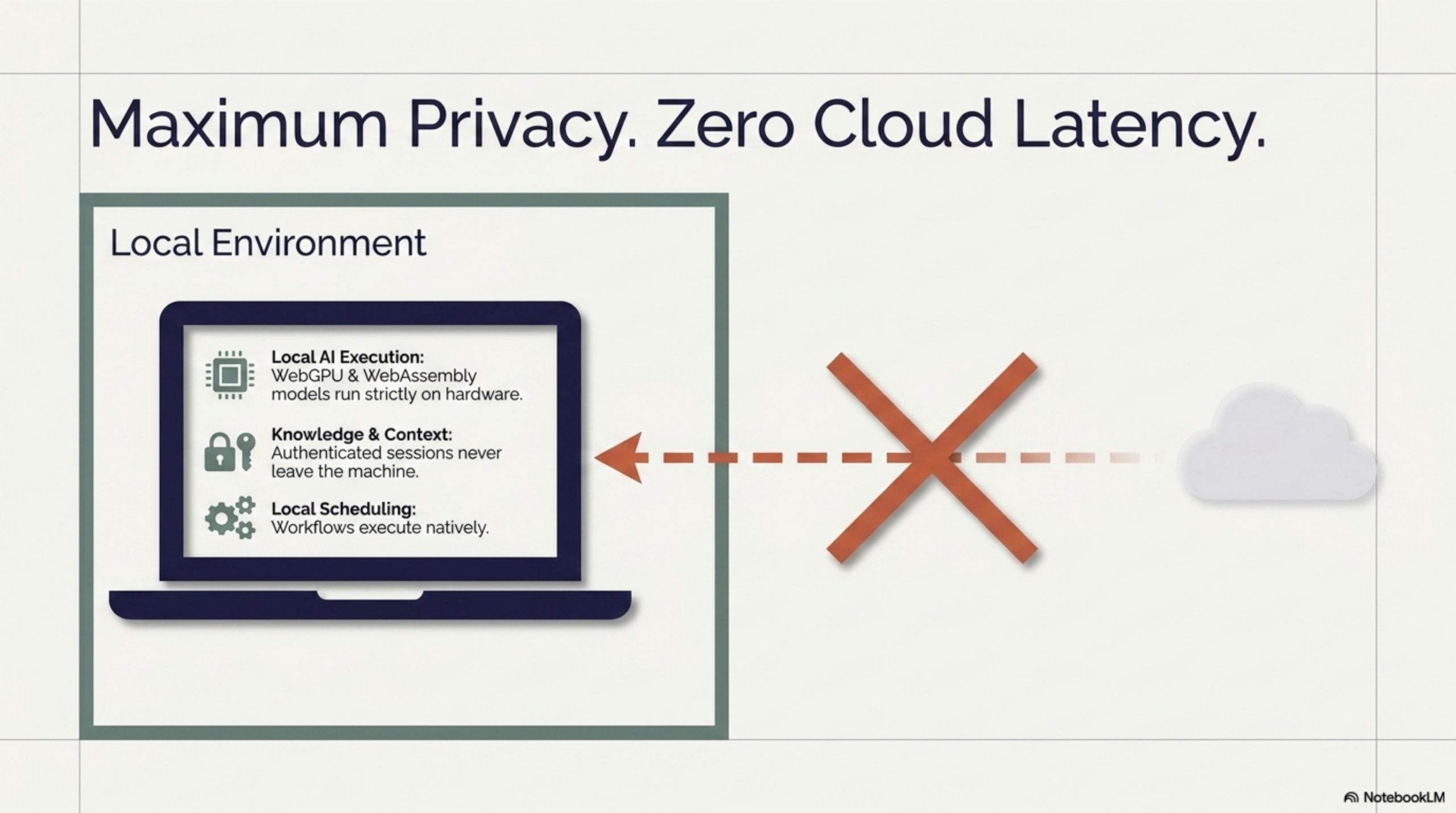
- “I need an API key for AI features.” Agentic Workflow supports local AI via Ollama and WebLLM, meaning AI processing can run entirely on your machine with no external API.
- “This is only useful for developers.” The entire point of Agentic Workflow is the opposite. Marketers, researchers, analysts, and operations professionals are exactly the target audience.
- “It’s not secure — my data goes to a server.” Everything runs in your browser. No data leaves your machine unless you explicitly connect an external LLM API.
Conclusion
Browser automation no longer requires a computer science degree. With tools like Agentic Workflow, the skill barrier has been removed entirely — what’s left is just creativity and a clear idea of what you want to automate. Whether you’re a marketer extracting campaign data, a researcher compiling sources, or an operations professional tired of manual data entry, no-code browser automation is ready for you right now.
Ready to start? Install Agentic Workflow from the Chrome Web Store and build your first no-code browser automation today — no developer required.

What Is an Agentic Workflow? (And Why It’s Different from Regular Automation) » Agentic Workflow
April 27, 2026[…] is the universal interface. This makes it the most natural place to deploy agentic workflows, and browser-based automation has never been more accessible to non-technical […]
The 5-Tab Problem: How Knowledge Workers Lose 2 Hours a Day to Browser Switching » Agentic Workflow
April 27, 2026[…] AI and automation directly to the pages where your work actually happens. And the good news is that browser automation is no longer just for developers — you can build your first workflow without writing a single line of […]
Build an AI Form-Filler That Works on Any Website » Agentic Workflow
April 27, 2026[…] infrastructure, and are overkill for individual or small-team use. If you’re not a developer, browser automation for non-developers is a more practical starting […]
5 Browser Tasks You’re Doing Manually That AI Can Do for You » Agentic Workflow
April 27, 2026[…] already be handled by AI. Not by a complex server-side script or a developer-built bot, but by a no-code workflow running directly in your browser. Here are five tasks that are costing you hours every week — and […]